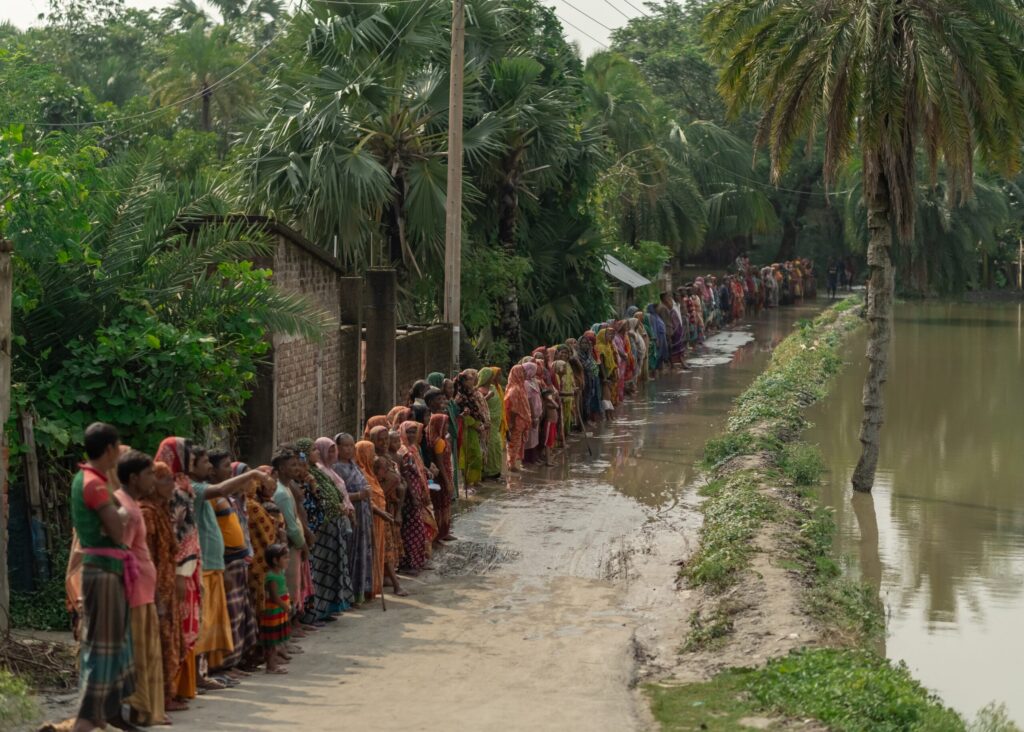
© BothENDS – Human chain to urge action from local governments in southwest Bangladesh
Each year, International Women’s Day is an opportunity to recognise the women advancing change in their communities and across the world. The 2026 theme — “Rights. Justice. Action.” highlights a stark reality: women and girls still hold only a fraction of the legal rights compared to men in many countries, and barriers to justice continue to limit their ability to shape decisions that affect their lives and livelihoods.
Through its portfolio, the Global EbA Fund supports catalytic projects that strengthen the enabling conditions for ecosystem-based adaptation (EbA) while embedding gender-inclusive approaches across design, implementation, and monitoring. By creating spaces for women’s participation, integrating their knowledge and priorities, and addressing gender-specific climate risks, these initiatives help ensure that adaptation solutions are both equitable and grounded in local realities.
On this International Women’s Day, we spotlight several Global EbA Fund grantee projects that demonstrate how rights, justice, and action can translate into tangible progress for communities and ecosystems alike.

Nepal: Women shaping climate resilience in the Bagmati floodplains
In Nepal’s Bagmati River basin, Heifer International, in partnership with Forest Resources Studies and Action Team and The Small Earth Nepal, is advancing community-led adaptation through the Building Agroforestry-based Adaptation Plans for Resilient Floodplains (BAGAR) project. The initiative brings together local communities and government authorities through newly established EbA Forums that guide climate planning in flood-prone landscapes. Designed with gender-inclusive facilitation methods, these platforms ensure women and marginalised groups can participate meaningfully in decision-making processes that influence land use, flood management, and agroforestry practices. Through consultations, surveys, and participatory assessments, women’s perspectives have informed key planning tools—including vulnerability assessments, land-use plans, and agroforestry guidelines—helping embed gender-responsive adaptation measures directly into municipal planning and budgeting processes. By ensuring that women’s knowledge shapes local policies, the project turns the principle of justice into practical climate action.
Bangladesh: Recognising gendered climate risks in tidal river management
In southwest Bangladesh, BothENDS, Uttaran and CEGIS, through the Tides are Changing: A People’s Plan for Upscaling Ecosystem-based Adaptation in the Tidal Rivers of Southwest Bangladesh project, are developing a People’s Plan to scale community-based tidal river management in the Betna-Marichhap basin. This locally led approach seeks to address chronic waterlogging and climate-driven challenges through ecosystem restoration, livelihood planning, and institutional collaboration. As part of the process, Uttaran conducted an in-depth gender analysis to better understand how climate impacts affect women and men differently. The findings revealed that prolonged waterlogging puts disproportionate burdens on women. By incorporating these insights into the People’s Plan, the project ensures that ecosystem-based solutions respond to the realities women face daily. The result is a more equitable adaptation strategy that recognises women not only as vulnerable to climate impacts, but as essential contributors to sustainable water management.

Ecuador: Women leading resilient livelihoods in the dry forest corridor
In Ecuador’s Chongón-Colonche mountain range, Fondazione ACRA is strengthening EbA in the Dry Forest Ecological Corridor through inclusive governance and community-driven adaptation planning. Recognizing that travel constraints and safety concerns can limit women’s participation, project partners bring trainings and technical support directly to communities—an approach that has resulted in women representing more than 70 percent of workshop participants. Through this engagement, women have played a central role in shaping livelihood and ecosystem strategies, from agroecological farming and sustainable goat husbandry to traditional water storage practices that enhance drought resilience. They have also contributed knowledge for technical studies assessing vulnerability and productive opportunities across the corridor. By combining ecosystem restoration with livelihood diversification and women’s leadership, the project demonstrates how gender-responsive EbA can strengthen both environmental stewardship and economic resilience.

Vietnam: Women influencing water solutions in the Central Highlands
The International Water Management Institute (IWMI), together with its partners – Dong A University and the Western Highlands Agriculture and Forestry Science Institute (WASI), is Enabling Smallholder Farmers to Better Manage Water-related Climate Risks in the Central Highlands of Vietnam with Novel Nature-based Solutions such as managed aquifer recharge. The project focuses on ethnic minority communities, where declining groundwater supplies increasingly threaten livelihoods. To ensure inclusive outcomes, project teams organise village-level discussions that create safe and accessible spaces for women to share experiences and shape decisions—particularly important given that women often manage household water supplies. Through these dialogues, women highlighted how shallow wells fail earlier each year, forcing them to travel farther to secure water for their families. These insights are directly informing the design of recharge systems tailored to domestic wells and community water needs. By translating women’s lived experiences into practical technical solutions, the project illustrates how inclusive adaptation processes can deliver more effective and just outcomes.

Vanuatu: Amplifying women’s knowledge in climate monitoring
Across the Pacific island nation of Vanuatu, the Earthwatch Australia Institute is empowering communities to monitor environmental change through ClimateWatch, a mobile platform that combines traditional knowledge with modern climate observation. Community members document ecosystem changes—from rainfall patterns to species observations—creating valuable data that supports local climate resilience. The project prioritises women’s participation by initiating consultations within existing women’s networks, such as community climate groups and rainfall monitoring initiatives, before expanding discussions to broader community meetings. These safe and supportive spaces allow women to share perspectives, ask questions, and shape how climate information is collected and used. With strong female representation among facilitators and careful handling of gender-sensitive traditional knowledge, the initiative ensures that women’s insights remain central to community-driven climate monitoring and adaptation.
Advancing rights through climate action
Across these diverse contexts—from floodplains and tidal rivers to forests, farms, and island ecosystems—the Global EbA Fund’s projects demonstrate that gender-inclusive ecosystem-based adaptation is not only possible, but essential. By strengthening women’s participation, integrating their knowledge, and addressing the specific challenges they face, these initiatives move beyond rhetoric to deliver tangible progress toward equality and resilience.
On this International Women’s Day, the message of Rights. Justice. Action. resonates strongly across climate and biodiversity efforts. When women have the opportunity to shape environmental decisions and adaptation strategies, communities are better equipped to protect both people and nature in a rapidly changing world.