Scaling what works for biodiversity and climate: taking community-led EbA from local action to systemic change
Date: October 29, 2026 / News
Community-led Ecosystem-based Adaptation (EbA) generates practical solutions that strengthen ecosystem integrity, build climate resilience, and improve local livelihoods. Across diverse contexts globally, these approaches have demonstrated what effective, locally grounded action can achieve. However, given the scale of the interconnected climate and biodiversity crises, successfully integrated local approaches must be delivered far more widely and systematically.
Community-led Ecosystem-based Adaptation (EbA) generates practical solutions that strengthen ecosystem integrity, build climate resilience, and improve local livelihoods. Across diverse contexts globally, these approaches have demonstrated what effective, locally grounded action can achieve. However, given the scale of the interconnected climate and biodiversity crises, successfully integrated local approaches must be delivered far more widely and systematically.
As CBD COP17 reflects on progress toward implementing the Kunming-Montreal Global Biodiversity Framework (KMGBF), a side event brought together perspectives across policy and practice, and government, civil society, and local implementation, to explore how successful community-led EbA can move beyond isolated projects toward lasting systemic change.
Jointly hosted by the Global EbA Fund and CBA SCALE+ – two initiatives supported by Germany’s International Climate Initiative – the session convened grassroots and subnational leaders alongside global partners, to reflect on actionable pathways for scaling community-led EbA. The session was moderated by Gregory Davies-Jones, Climate Change Programme Officer at IUCN.
Ecosystem-based Adaptation: Why it matters in an interlinked crisis
Opening the discussion, Sharon Gil, Head of Unit for Subnational Climate Action in UNEP’s Climate Change Division, emphasized that the climate crisis is fundamentally a ‘crisis of imagination’, as we have become accustomed to thinking of the future as an extension of the present, building and planning as we always have. However, the world is on a pathway to temporarily exceed 1.5°C of global warming, and the future will be shaped by the decisions we make today. This is a central message of UNEP’s Limiting Overshoot report.
The consequences will not be felt equally; there will be profound inequalities in how communities experience extreme heat, flooding, and other climate impacts, affecting livelihoods, ecosystems, and infrastructure, that are already under growing pressure.
EbA is a powerful approach for translating the ambitions of the KMGBF into tangible action, offering one of the clearest pathways for delivering biodiversity and climate objectives simultaneously. To scale this approach, we must embrace the extraordinary functions of nature in absorbing floodwaters, reducing exposure to extreme heat, and managing water resources. Protecting this everyday nature is not simply a biodiversity objective; it is an essential investment in the future of our society.
“The future does not simply happen. We build it through the decisions we make about what we protect and what we restore. The nature we protect today will determine what kind of future remains possible for us.” – Sharon Gil, UNEP
Diverse On-the-Ground Perspectives
Drawing on practical field experiences, panellists examined the enabling environments required to scale community-led EbA across three core pillars: knowledge integration, scaling pathways, and social inclusion.
- Knowledge integration
Panellists emphasized that sustainable adaptation relies on uniting diverse knowledge systems as equal partners. From a local perspective, Alec Crawford, Director, Nature for Resilience, IISD, noted that effective EbA must be built on integrated risk assessments – incorporating climate, biodiversity, gender, and conflict dynamics – while delivering early, tangible wins to establish community trust. Illustrating this in practice, Nancy Marangu, Policy and Strategy Specialist, Chemichemi Foundation, shared how Kenya’s multi-stakeholder water resource management builds true local ownership by entrusting shared governance to communities, women, and youth.
At the subnational and government levels, Rodrigo Corradi, Deputy Executive Director, ICLEI South America, highlighted that EbA succeeds where scientific data, community priorities, and municipal planning intersect, citing ICLEI’s work in Belém, Brazil. Complementing this, Edward Samuriwo, Director, Ministry of Environment, Climate and Wildlife, Government of Zimbabwe, introduced the concept of “ancestral intelligence” – generations of local ecological knowledge – as a cornerstone of sustainability. He emphasized that integrating local practices with technical research ensures genuine community ownership, noting, “The first question must always be: what are the priorities of the community, and how do those priorities connect with national priorities?”
- Scaling pathways
Moving from isolated pilot initiatives to landscape-scale impact requires dismantling structural barriers between national frameworks and local realities.
At the local level, Nancy stressed building a robust evidence base through disaggregated data – monitoring impacts across women, youth, and persons with disabilities – to support replication and scaling, noting, “when communities feel ownership and institutions work together effectively, scaling becomes much more sustainable.”
Rodrigo pointed out that global financial architectures remain largely disconnected from subnational priorities, leaving direct funding for local implementation as a primary barrier to scale. To bridge national policy with local execution, Edward outlined Zimbabwe’s dual approach: leveraging local structures like Ward Development Committees to funnel grassroots priorities into national budgets and mandating a whole-of-government policy direction where all ministries integrate climate resilience into annual planning.
Building on these policy dynamics, Alec mentioned that a review across four Southern African countries found that while climate adaptation is widely referenced in national policies, locally led adaptation is rarely mentioned. He called for vertical integration to align national policy instruments and policies to equip subnational authorities with the mandates, resources, and authority required to scale on-the-ground solutions.
- Social inclusion
Panellists agreed that meaningful inclusion requires integrating local knowledge systems with equal opportunity and continuous community agency. To achieve demands harmonizing scientific data with Indigenous knowledge under Free, Prior, and Informed Consent (FPIC), while eliminating top-down governance so underrepresented groups participate as equal decisionmakers. To sustain involvement, participation must move beyond attendance toward long-term capacity building, mentorship, and transparent benefit-sharing that protects against elite capture.
Social inclusion must be embedded directly into a project’s “DNA” – from risk assessments to implementation – supported by meaningful engagement of local and grassroots organizations. Moving past one-off consultations to co-design and co-implementation ensures that local populations shape solutions and experience lasting benefits.

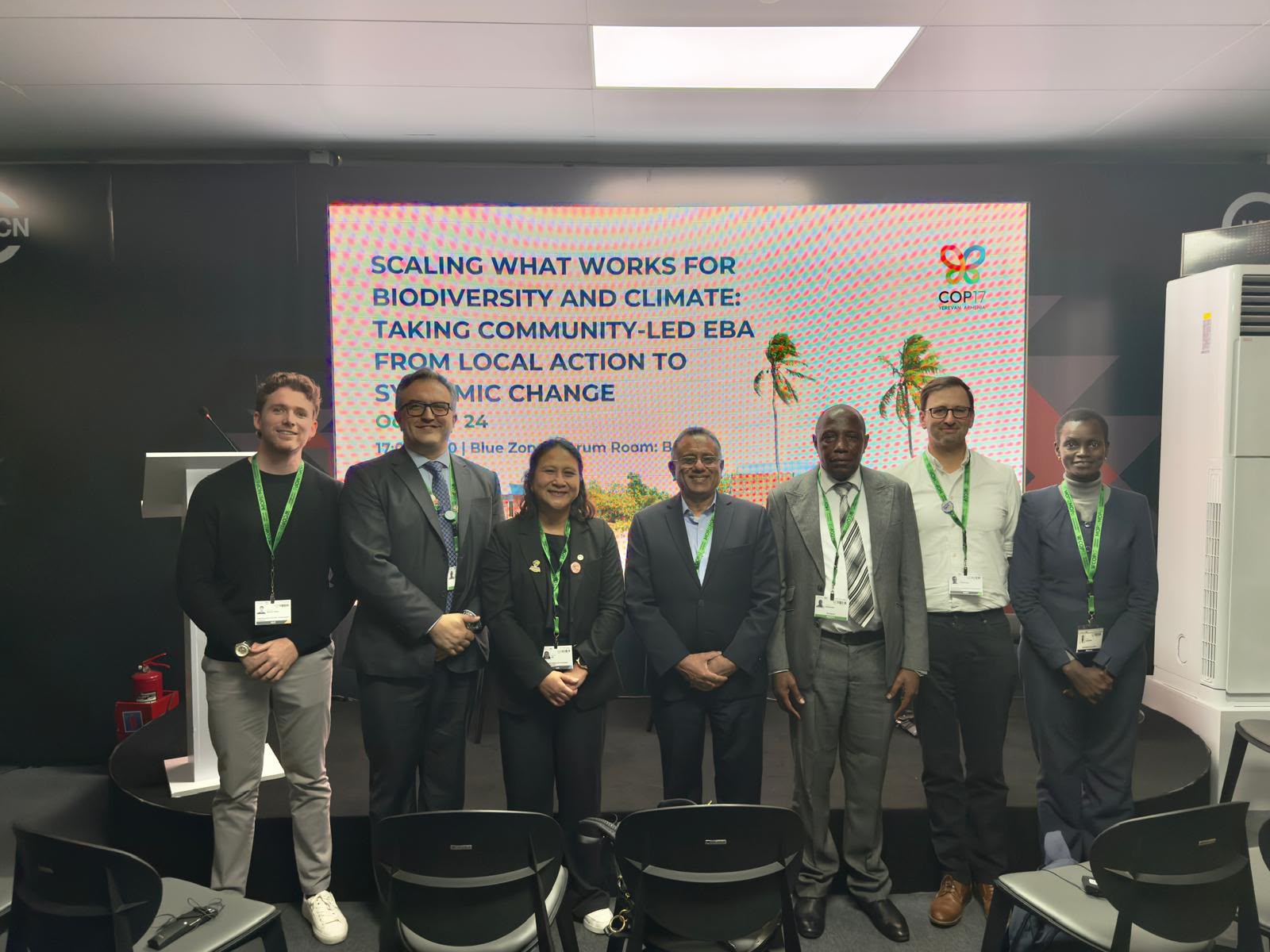
© IUCN – panel discussion
Key takeaways
To conclude the discussion, panellists outlined four essential takeaways for transitioning community-led EbA from local action to systemic change:
- Integrate the “three Cs”: Systemic scaling relies on co-designing initiatives to foster ownership, communicating in local languages and contexts, and coordinating bottom-up action with policy structures.
- Value contributions to build ambassadors: Recognizing the local knowledge and efforts fosters transparent, equitable outcomes, turning participants into active ambassadors who inspire neighbouring communities to scale EbA organically.
- Demonstrate direct and tangible benefits: Projects must respect the time communities invest by delivering visible, timely livelihood benefits that directly improve daily lives.
- Unlock local finance and capacity: Direct financial access and technical capacity building must be routed to subnational governments and community groups so they can innovate and replicate solutions.
Closing Remarks: Promoting scaling through true ownership
Closing the session, Ali Raza Rizvi, Director of IUCN’s Climate Change and Energy Transition Team, reflected on the enduring trajectory of the EbA approach since its inception back in 2008, its formal adoption by the CBD in 2009/2010, and its subsequent integration into the UNFCCC process. He noted that while many climate concepts have emerged and disappeared over the years, EbA has sustained global momentum and growing financial support, because it inherently bridges three vital dimensions: ecological integrity, social equity, and economic viability.
To ensure future initiatives achieve true impact and longevity, Ali highlighted several non-negotiable priorities: Firstly, projects must maintain a balanced comprehensive approach that addresses climate resilience, socio-economic needs and biodiversity conservation. Secondly, true scaling and sustainability arise only when communities and local governments hold genuine decision-making power rather than being treated as passive participants. And thirdly, foundational values – partnerships, local ownership, gender equality, and social inclusion – are not optional checklist items, but essential cornerstones to ensure successful interventions.
Ali concluded: “Unless local ownership exists, scaling will not happen. Only when communities own the process can we demonstrate real returns on investment. Only when local governments take ownership will approaches continue after project funding ends.”