
The “Pecha Kucha on Rio Synergies: Connecting locally led actions with global agendas for scaling impact,” organised by the IUCN Climate Change and Energy Transition Team together with the IUCN Centre for Policy and Law, brought together voices from Zimbabwe, Brazil, Mongolia, Egypt and Türkiye, and presented three IUCN climate initiatives: CBASCALE+, the Global EbA Fund and the ENACT Partnership.
The discussion built on the Ulaanbaatar Technical Dialogue on Rio Synergies, held earlier that day, where 23 countries and the EU shared experiences of advancing synergies at national and subnational levels. Together, the discussions pointed to a clear conclusion: the foundations for greater cooperation already exist – the challenge is to turn them into coordinated action, investment and impact.

© IUCN – Stewart Maginnis, IUCN Deputy Director General
The real test of synergies is what happens on the ground
Opening the reception, Stewart Maginnis, IUCN Deputy Director General, highlighted the growing momentum behind the synergies agenda – but stressed that international discussions must ultimately translate into national decisions and local action.
“The technical dialogue today demonstrated that there is real appetite to build synergies from the bottom up.”
For Maginnis, Nature-based Solutions (NbS) provide an important practical entry point. Climate change, biodiversity loss and land degradation are not experienced separately by communities, nor do they affect separate landscapes. NbS can therefore help connect national strategies and investments across the three Rio Conventions.
His message was also one of pragmatism: countries and institutions do not need to create entirely new systems. Existing initiatives and partnerships, including the ENACT Partnership, can provide platforms for cooperation, learning and exchange.
As Maginnis put it, synergies need to move beyond international discussions and into “national policies, investment decisions and action on the ground.”

© IUCN – Hon. Sam Matema, Member of Parliament and Chair of Zimbabwe’s Parliamentary Portfolio Committee on Environment, Climate and Wildlife
Zimbabwe: making local knowledge and national priorities work together
Hon. Sam Matema, Member of Parliament and Chair of Zimbabwe’s Parliamentary Portfolio Committee on Environment, Climate and Wildlife, brought the perspective of national and community-level implementation through the CBA SCALE+ project.
The project demonstrates how community-based adaptation can connect national climate, land, biodiversity and development priorities with practical on-the-ground action, including wetland rehabilitation, tree planting and land restoration in districts such as Bikita and Chiredzi.
Hon. Matema stressed that the value of synergies should not be measured simply by the number of initiatives being implemented.
“It’s not so much about building synergies but it is the value that we should get out of those synergies.”
For Zimbabwe, that means ensuring that projects translate into higher household incomes, poverty reduction and stronger community economic resilience, alongside environmental outcomes.
He also emphasised the importance of combining scientific approaches with Indigenous Knowledge Systems: “Scientific interventions alone are not enough. Indigenous knowledge systems … must converge with conventional science.”
For this approach to succeed, communities need genuine ownership, while parliamentarians, local authorities, traditional leaders and development partners need to be part of the same conversation.
Hon. Matema described CBA SCALE+ as “far more than a climate adaptation project; it is an investment in our people, our land and our collective resilience.”

© IUCN – Enni Kallio, IUCN
Brazil: demonstrating that urban action can deliver multiple benefits
The Global EbA Fund brought another dimension to the discussion: demonstrating, through a specific example, how synergies can be delivered in cities.
Enni Kallio, Global EbA Fund, introduced the Fund’s role in supporting innovative and catalytic projects that demonstrate the connections between land, biodiversity and climate. The Fund now has 75 projects across 41 countries, at different stages of implementation, with more to come.
She then handed over to Rodrigo Corradi of ICLEI South America, who shared the experience of the Global EbA Fund-supported Nature-Based Cities: Biodiversity and Climate Resilience on Urban Development project in Belém, Brazil.

© IUCN – Field visit at the Belém project
Corradi highlighted how local action can translate global synergies into practical results, sharing ICLEI’s work with the city of Belém, Brazil. Through the project, the city strengthened its capacity to integrate biodiversity and climate considerations into urban planning, using ecosystem services diagnostics and climate risk assessments to inform its Climate Action Plan. The project also helped advance the inclusive development of an urban NbS project to strengthen Belém’s access to finance and build strategic partnerships.

© IUCN – John Juhyun Jeong, Mongolia Country Director at ADB
Mongolia: synergies must change investment decisions
If synergies are to move beyond policy statements, they must also influence where money goes.
John Juhyun Jeong, Mongolia Country Director at the Asian Development Bank (ADB), made the investment case by starting with a simple observation: “We may have three Rio Conventions, but countries have one landscape, one economy and one set of communities.”
In Mongolia, rangelands illustrate this intersection clearly. They sustain rural livelihoods and livestock value chains, store carbon, support biodiversity and help communities withstand drought. When rangelands degrade, all of these benefits are affected simultaneously.
Jeong pointed to ADB’s investment programmes in Mongolia as an example of how infrastructure, sustainable rangeland management, climate-resilient livestock value chains and rural finance can be brought together.
For development finance institutions, the opportunity is to recognise the multiple benefits generated by the same investment, build bankable project pipelines and combine public, concessional and private finance according to the risks each is best placed to manage.
His central message was particularly clear: “Rio synergies should not be measured by how closely three plans are aligned on paper. They should be measured by whether that alignment changes investment decisions on the ground in Mongolia.”

Egypt: turning political commitment into practical cooperation
The conversation then moved from investment to policy coherence, with Prof. Dr. Ahmed Abdelati Ahmed, Government of Egypt, reflecting on Egypt’s experience of advancing synergies across institutions and conventions.
Egypt has been a key driver of the ENACT Partnership since its launch at COP27 in Sharm El-Sheikh, alongside Germany and IUCN. Abdelati highlighted how Egypt has sought to strengthen coordination between ministries responsible for the different Rio Conventions.
He stressed that the synergies agenda is not new, but that it now needs stronger implementation and regional cooperation.
He also called for greater regional collaboration, including through African institutions, and encouraged partners to join ENACT and contribute to the collective effort.
The vision, he suggested, is to demonstrate that integrated action can move from individual countries to a broader regional agenda – delivering benefits for both people and nature.

© IUCN – Emine Aydınoğlu, Türkiye COP31 Presidency
Türkiye: the first step is bringing institutions together
Emine Aydınoğlu, Türkiye COP31 Presidency, shared a practical example of how institutional coordination can begin at the national level.
With the three Rio Conventions represented by different focal points across two ministries in Türkiye, the country established a Rio Synergy Protocol, followed by a joint national working group and workplan.
The approach does not claim to have solved every challenge. Instead, it demonstrates the importance of creating a mechanism through which institutions can begin working together.
“I cannot say we have solved everything yet. But we took the first step together. And that is a significant beginning.”
Türkiye’s COP31 Presidency is continuing to advance Rio synergies through its Action Agenda and a series of technical dialogues, working with partners including IUCN, ENACT and the G20 Global Land Initiative.
From dialogue to delivery
Across the different perspectives, a common picture emerged.
- Action coherence means connecting community-led initiatives with national priorities and ensuring that Indigenous and local knowledge informs implementation.
- Investment coherence means recognising that the same landscape, community or intervention can generate climate, biodiversity, land and livelihood benefits – and structuring finance accordingly.
- Policy coherence means connecting institutions and national focal points with one another to create coherent vision and ambition that reinforces the country-led priorities under each global agenda.
And underlying all three – action, investment and policy – is the recognition that nature provides a common denominator.
The examples shared at the reception demonstrated that Rio synergies are not simply an aspiration for future negotiations. They are already visible in community adaptation initiatives in Zimbabwe, urban planning in Brazil, rangeland investment in Mongolia and national coordination mechanisms in Egypt and Türkiye.
The task now is to connect, strengthen and scale what is already working and to identify where gaps exist or further action is needed.
From Ulaanbaatar to Antalya: building the next chapter
The reception also marked another step in a wider process of dialogue and collaboration running through the 2026 “triple COP” year.
The Ulaanbaatar Technical Dialogue, convened by the Türkiye COP31 Presidency, and supported by IUCN through the ENACT Partnership and the G20 Global Land Initiative, demonstrated strong interest from Parties and partners in advancing synergies from the bottom up. Countries across all regions intervened during the dialogue, sharing national and subnational experiences.
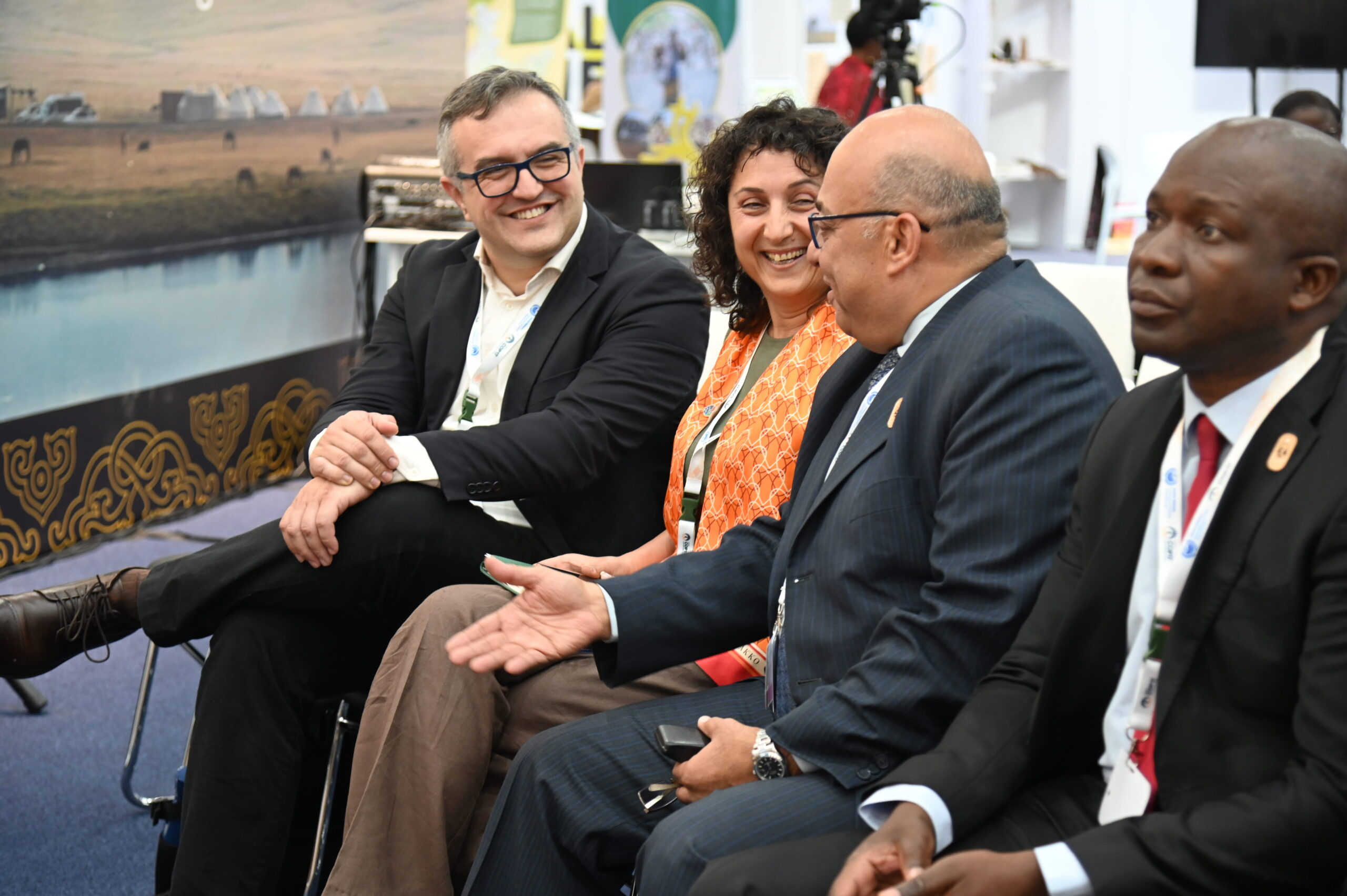
The reception created space to take those discussions beyond the formal setting – connecting policymakers, practitioners, financing institutions and partners around practical examples.
As Stewart Maginnis reflected in closing, “Pecha Kucha is Japanese and means chit-chat, and this is what we want to spark today: chit-chat among the diverse stakeholders working on Rio synergies to create the connections and collaborations we need to make synergies happen on the ground.”
Those connections will continue through the Rio Synergies Technical Dialogue series, building towards COP31 in Antalya.
The ambition is ultimately straightforward: not simply more dialogue on synergies, but more coherent action, investment, policy and subsequently impact for people and nature.